
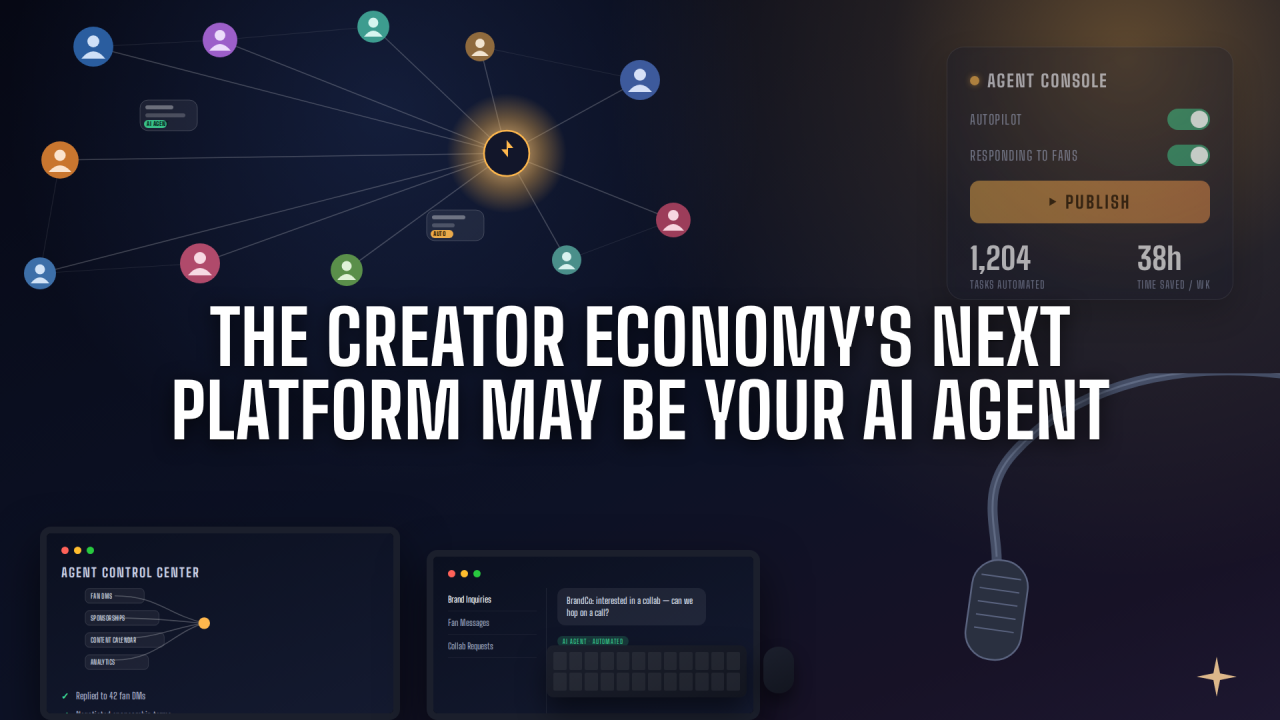
The Creator Economy’s Next Platform May Be Your AI Agent
The creator economy spent the last twenty years optimizing for algorithms. The next twenty may be about optimizing for agents instead.
The biggest change coming to the creator economy may not be another social network.
It may be the slow disappearance of the social network as the primary relationship between creators and their audiences.
For twenty years, creators have built their audiences inside platforms. YouTube owns the subscriber relationship. TikTok owns the “For You” feed. Instagram decides which followers actually see a post, and Spotify controls podcast discovery almost entirely. Even when someone deliberately chooses to follow a creator, an algorithm still sits between them, deciding what surfaces, when it appears, and how much attention it earns.
That arrangement has become so normal that most of us stopped questioning it.
AI agents may change the architecture underneath it.
As personal agents grow more persistent, more local, and more capable of acting on our behalf, the relationship could shift from creator → platform → audience into something far more direct: creator → audience agent → audience.
It looks like a small technical change. It may turn out to be one of the largest shifts in media distribution since the algorithmic feed itself.
The Algorithm Has Always Been the Middleman
Creators like to talk about owning their audience, but most of them don’t really own that relationship. They rent access to it.
A creator can have a million followers and still have no reliable way to reach them. Distribution runs through platform ranking systems, engagement signals, recommendation models, and whatever the platform’s advertising strategy happens to favor that quarter.
That creates a strange imbalance. Creators produce the content and audiences choose the creators, but the platform controls the connection between them.
Creators aren’t only creating for their audience. They’re creating for the machine standing between them and it.
This is why creators keep adapting themselves to algorithms rather than the other way around. Thumbnails change, video lengths change, posting schedules shift, and entire creative strategies get rebuilt around whatever the platform is currently rewarding.
AI agents could quietly remove that machine from the equation.
Your Agent Could Know Your Creators
Imagine skipping five different apps every morning and asking your personal agent one question instead: “What did the creators I follow publish yesterday that I’d actually care about?”
The agent already knows who you follow, what you finished, what you abandoned thirty seconds in, and how much time you have before your next meeting. More importantly, it could know a creator’s entire catalog, not just their newest post.
A creator could expose a structured feed of episodes, articles, transcripts, clips, research, products, and community conversations that an agent can query directly. The agent might respond:
“You have twenty minutes before your next meeting. David published a 48-minute podcast yesterday, but the section from 18:40 to 27:10 is specifically about AI agents replacing media discovery. I think you’d want that part.“
That’s a fundamentally different discovery model. The platform isn’t choosing what you see anymore. Your agent is.
Discovery May Move From Feeds to Intent
Today’s creator economy runs on feeds, and feeds optimize for one question: what should we show this person next to keep them scrolling.
Personal agents may optimize for a different question entirely: what does this person actually want right now.
That distinction matters more than it sounds. Someone researching AI product management probably doesn’t need another viral clip. Their agent could search ten trusted creators’ catalogs, surface three relevant podcast segments, summarize two articles, and queue a longer interview for later. Discovery shifts from what’s trending to what’s actually relevant, and that could quietly erode one of the biggest advantages platforms hold today: centralized recommendation.
TikTok’s recommendation engine is valuable because TikTok knows an enormous amount about what people watch. But the calculus changes once your personal agent knows more than that. It may know your work, your interests, your calendar, your reading habits, your purchases, and the goals you’ve never posted about anywhere.
The recommendation layer may be migrating away from the platform and toward the user. That’s the shift worth watching closely.
The Creator Relationship Could Become Portable
This also changes what it means to follow someone.
Today, following is platform-specific. You follow on YouTube, subscribe on Spotify, follow again on Instagram, and maybe join a Substack or Patreon on top of that. The relationship stays fragmented across every platform a creator happens to use.
An agent-native relationship could become portable instead. You might simply tell your agent to follow everything a creator publishes, and from that point forward it tracks them across podcasts, articles, videos, newsletters, and platforms that don’t exist yet.
The creator identity becomes the durable layer, and the platforms become interchangeable delivery channels underneath it. Today the architecture runs platform → creator → content. Tomorrow it may run creator → content graph → agents → platforms, which effectively reverses who holds the power in that chain.
Creator Data Is About to Become Extremely Valuable
If this plays out, creators will need something most of them don’t have yet: a machine-readable version of themselves. Not an AI clone pretending to be them, but a structured knowledge layer built from their actual body of work — episodes, transcripts, opinions, references, products, and the full history of what they’ve made.
This gets more interesting once you realize AI discovery doesn’t have to operate at the content level. It can operate inside the content. A two-hour podcast isn’t one piece of media to an agent; it may contain fifty individually addressable ideas, each one retrievable on its own.
Most creators have produced hundreds of hours of video and years of conversations that effectively disappear into an archive nobody revisits. Agents can make that catalog liquid again, turning the long tail of a creator’s work into something searchable and rediscoverable.
That may be one of the most underappreciated opportunities in AI media right now — bigger, in some ways, than the clip or the post that gets made from it.
Platforms Aren’t Going Away
YouTube, TikTok, Spotify, and Instagram aren’t disappearing. They still provide real value in distribution, hosting, payments, identity, advertising, and creator tools that nobody is replacing overnight.
What may change is their role. Platforms could shift from owning the audience relationship to becoming infrastructure the relationship runs on top of – a subtle distinction, but an important one. The web did something similar to traditional media distribution decades ago, decoupling content from any single physical channel. AI agents may do the same thing to algorithmic distribution: the content still lives on the platform, but the discovery happens somewhere else entirely.
The Next Creator Metric May Be Agent Subscribers
If this model takes hold, creator analytics need to change with it. Followers and subscriber counts may matter less than something closer to:
Active Agent Relationships – AAR
AAR is – how many personal agents are tracking a given creator, how often their content surfaces in agent recommendations, and which parts of their catalog actually get retrieved could become the new funnel: agent discovery → content retrieval → engagement → relationship → revenue.
That funnel implies an entirely new category of creator infrastructure – agent-readable content feeds, creator identity protocols, catalog APIs, semantic indexing, and direct agent commerce. Somebody is going to build that layer, the same way somebody built the ad exchange underneath programmatic media.
Where Chatmosa, Inc. Fits
This is part of why I think the future of Chatmosa goes beyond helping someone publish a podcast episode.

A podcast shouldn’t just produce an audio or video file. It should produce a body of knowledge – the full episode, the transcript, the key moments, the quotes, the clips, the articles, and the people and products connected to it. At Chatmosa, we’ve started thinking about a podcast session as the beginning of a creator content graph rather than the end of one.

Today that graph helps creators turn a single conversation into many pieces of content across existing platforms.
The next step is more interesting: that same structured content could become something AI agents understand directly. Instead of an algorithm recommending the latest episode, a listener’s personal agent could ask what a creator has said about AI agents and the creator economy over the last six months, and get back the exact episode, moment, or clip that answers it.

That changes what a podcast platform is for. It stops being just where content gets published and starts becoming part of the creator’s intelligence layer — a natural extension of the argument I made in AI Is Making Business Rules the New Product, where the durable value sits in the layer that governs how a system behaves, not the raw output itself.
Final Thought
The creator economy spent the last twenty years optimizing for algorithms. The next twenty may be about optimizing for agents instead.
That doesn’t mean creators start producing robotic content designed for machines to parse. I think the opposite happens. If personal agents get good enough at finding exactly what someone wants, creators may spend less time chasing algorithmic trends and more time building a distinctive body of work that’s actually worth retrieving.
The most valuable asset may no longer be the follower count. It may be the relationship between a creator’s knowledge graph and the millions of personal AI agents that know when that creator has something relevant to say.
Platforms won’t lose because people stop using them. They’ll lose gatekeeper power because discovery quietly moves somewhere else — one recommendation at a time.
The creator economy was built around direct-to-consumer. The next phase may be direct-to-agent, and from there, finally, back to the consumer.
#AI #CreatorEconomy #AIAgents #Podcasting #Media #FutureOfMedia Chatmosa, Inc.